
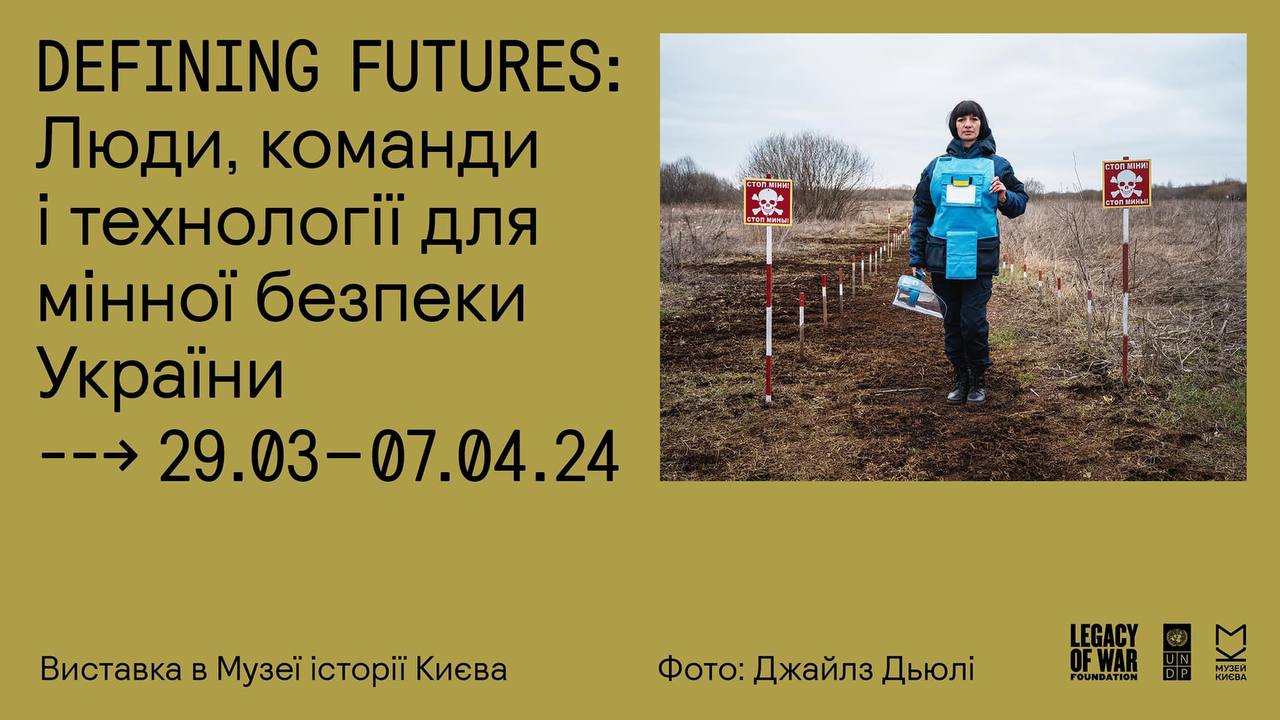
Kyiv, 29 March 2024 – The United Nations Development Programme in Ukraine (UNDP) opened in Kyiv the exhibition “Defining Futures: People, Teams and Technologies for Mine Safety in Ukraine” by photographer Giles Duley, the UN Global Advocate for Persons with Disabilities in Conflict and Peacebuilding.
This exhibition is a joint project of UNDP and the charitable organization Legacy of War Foundation, dedicated to the International Day for Mine Awareness and Assistance in Mine Action, which is observed every year on 4 April. The aim of the exhibition is to raise awareness of mine action and support for people affected by explosive hazards through a collection of a mosaic of experiences – from a professional deminer to a veteran, from a medical worker to a technological innovator.
The exhibition was opened on March 29 at The Museum of Kyiv History (7 Bohdana Khmelnytskoho Street) in the format of a closed presentation for ambassadors from different countries that support mine action in Ukraine. The exhibition will run in the museum until 7 April. From April 4 to April 19 the exhibition will also be available in an open-air format in the center of Kyiv – at Sofiyska Square.
During the exhibition opening, photographer Giles Duley noted that his goal was to encourage action to improve the situation with landmine contamination in Ukraine.
“Through this exhibition, I hope to show the realities of Ukraine’s contamination with landmines and unexploded ordnance,” Duley said. “I want us – governments, NGOs, businesses, and each of us individually – to ask ourselves: are we doing everything possible to leave a peaceful, safe, and mine-free Ukraine as a legacy for future generations?”
“Of course, no photograph can change the world – but I hope it can inspire those who can make a difference. That is why I do this – to be a storyteller for those who can support these demining efforts.”
First Vice Prime Minister – Minister of Economy of Ukraine Yulia Svyrydenko emphasized that it is extremely important to also pay attention to the economic aspect of mine contamination, particularly its impact on the agricultural sector.
“Ukraine is an agricultural country, with about 30% of its territory potentially contaminated by explosive ordnance,” she added.
“This is a tremendous loss. People cannot work this land. Therefore, our task is to improve approaches to humanitarian demining, strengthen technologies, and refine methodologies to return these lands to use as quickly as possible. And, of course, above all, this is an investment in the safety of Ukrainians living in de-occupied territories or returning there.”
UN Resident Coordinator in Ukraine Denise Brown emphasized the need for immediate and intensified collective action to address landmine contamination and other explosive remnants of war in the country.
“This exhibition demonstrates the scale of the challenges facing people in Ukraine,” she added. “The longer it takes to restore agricultural lands, forests, and destroyed cities, the longer Ukrainians will remain in danger and unable to recover from the consequences of the Russian invasion. We are committed to supporting Ukraine in carrying out this critically important task, with the backing of the international community and the help of innovative technologies developed in this country. This is one of the first steps toward enabling people to rebuild their lives.”
Roman Prymush, Deputy Head of the State Emergency Service of Ukraine (SESU), noted that the joint mission of SESU and its partners is to make maximum efforts to quickly de-mine de-occupied territories while ensuring the safety of Ukrainians.
“Our sappers work every day,” he added. “However, the volume of work is enormous. Since the beginning of the war, we have felt tremendous support from our international friends and partners. I would like to take this opportunity to once again express my gratitude for the technical assistance provided to our service.”
For reference:
Photographer Giles Duley has documented the global impact of landmines and unexploded ordnance on civilians for over 20 years, often decades after the end of conflicts, in countries such as Angola, Cambodia, Laos, Colombia, Lebanon, Iraq, and Vietnam. Since 2015, he has been documenting land contamination in Ukraine. Duley founded the charitable organization Legacy of War Foundation, which supports communities affected by conflict worldwide, including Ukraine. He is a triple amputee, having lost both legs and his left arm due to an improvised explosive device in Afghanistan in 2011. In 2024, Duley was awarded the Order of the British Empire (MBE) for his services in supporting victims of explosive remnants.
UNDP in Ukraine expresses its deep gratitude to state institutions, including the National Mine Action Authority, the State Emergency Service of Ukraine, and the Ministry of Economy of Ukraine, as well as to embassies, Ukrainian and international NGOs, and all those who contributed to the realization of this exhibition. We also thank the European Union, and the governments of Canada, Croatia, Denmark, France, Germany, Japan, the Republic of Korea, Malta, the Netherlands, New Zealand, Norway, Spain, Sweden, Switzerland, and the United Kingdom for their support of mine action in Ukraine.