
One of the most valuable historical images is the portrait. Through it, a historian can study not only the appearance of a particular person, but also the era to which the portrait monument belongs. So-called family portraits have their own specific character, that is, those commissioned by a person for their family, as a keepsake for their descendants. Thus, dynastic portrait galleries of wealthy families emerged, through which one can study changes in appearance, the spiritual world of people, and the historical conditions of life.
When photography was invented in the 1820s, this new astonishing invention quickly spread across the world. The technology reached Ukrainian lands in the early 1840s. At large markets (for example, at the Kyiv Contracts), this wonder was demonstrated by foreign photographers — the public was delighted. Later, local enthusiasts of fashionable gadgets took over the initiative. Gradually, photo studios began to appear in Kyiv.
The history of the family photo portrait genre began around the same time. The first photographic portraits appeared in the 1830s, but the technology of producing images was complex, and therefore the creation of a family photograph was a joyful festive event. On the day of the photo session, people prepared in advance, dressed in their most festive clothes, and the whole family would go to the photographer in a good mood and with joyful smiles.
By the early 20th century, photography had become a routine part of Kyiv residents’ lives.
During the scientific work on the creation of the new museum “Manor on Kudriavka,” a large number of interesting materials were collected, especially photographs of Kudriavka and its residents.
Kudriavka has long been a powerful center of education and science — the Kyiv Theological Seminary, the Astronomical Observatory, and the People’s Auditorium. At various times, Ivan Franko, Ivan Nechui-Levytskyi, Fedir and Vasyl Krychevskyi, and Mykola Lysenko lived here. During the Ukrainian Revolution, the barracks of the Sich Riflemen Corps were located on Voznesenskyi Descent, led by the famous colonels of the UNR army Yevhen Konovalets and Andrii Melnyk.
In the building of our museum at 9 Kudriavska Street lived very interesting personalities — lecturer Andrii Demutskyi, Professor M. Drozdov, educator V. Petrova, widow of councillor O. Liashenko, and theologian Afanasii Bulhakov. In March 1911, the estate was purchased by publicist and civic activist Pavlo Maziukevych. In the same year, a wing was built to his commission according to the design of V. Krychevskyi, where later lived Mariia Hrinchenko, a writer and translator, and the artist Dinora Maziukevych, a well-known researcher of Kyiv and author of a model of ancient Kyiv of the 10th–13th centuries, which is exhibited in Saint Sophia Cathedral.
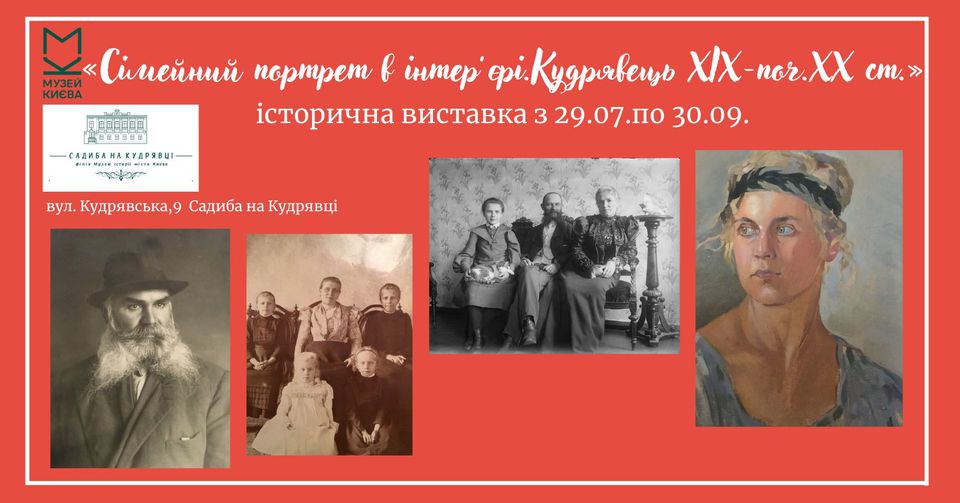
The exhibition tells not only about famous people but also about ordinary residents of Kudriavka in the 19th century, who can be seen in family photographs from private collections, about their everyday life, interiors, preferences, and hobbies, about the books they read, and what they wrote in handwritten albums. The two oldest photographs date back to 1878 and are presented in their original form. These are images of a young couple who, from 1889, lived at 10 Kudriavska Street, where their descendant still lives today. Also exhibited are photo copies of views of Kudriavka from the 19th century from the collections of the Museum of Kyiv History, which have never been shown before. Furniture, tableware, embroidery, engravings, and accessories of the 19th century belong to the museum’s collections and carry the touch of the era, its mood, thoughts, and tastes of its contemporaries.
The significance of these photographs is especially great, as they preserve for us what has long since disappeared and faded from memory, reminding us of what Kyiv and its inhabitants were like hundreds of years ago.