
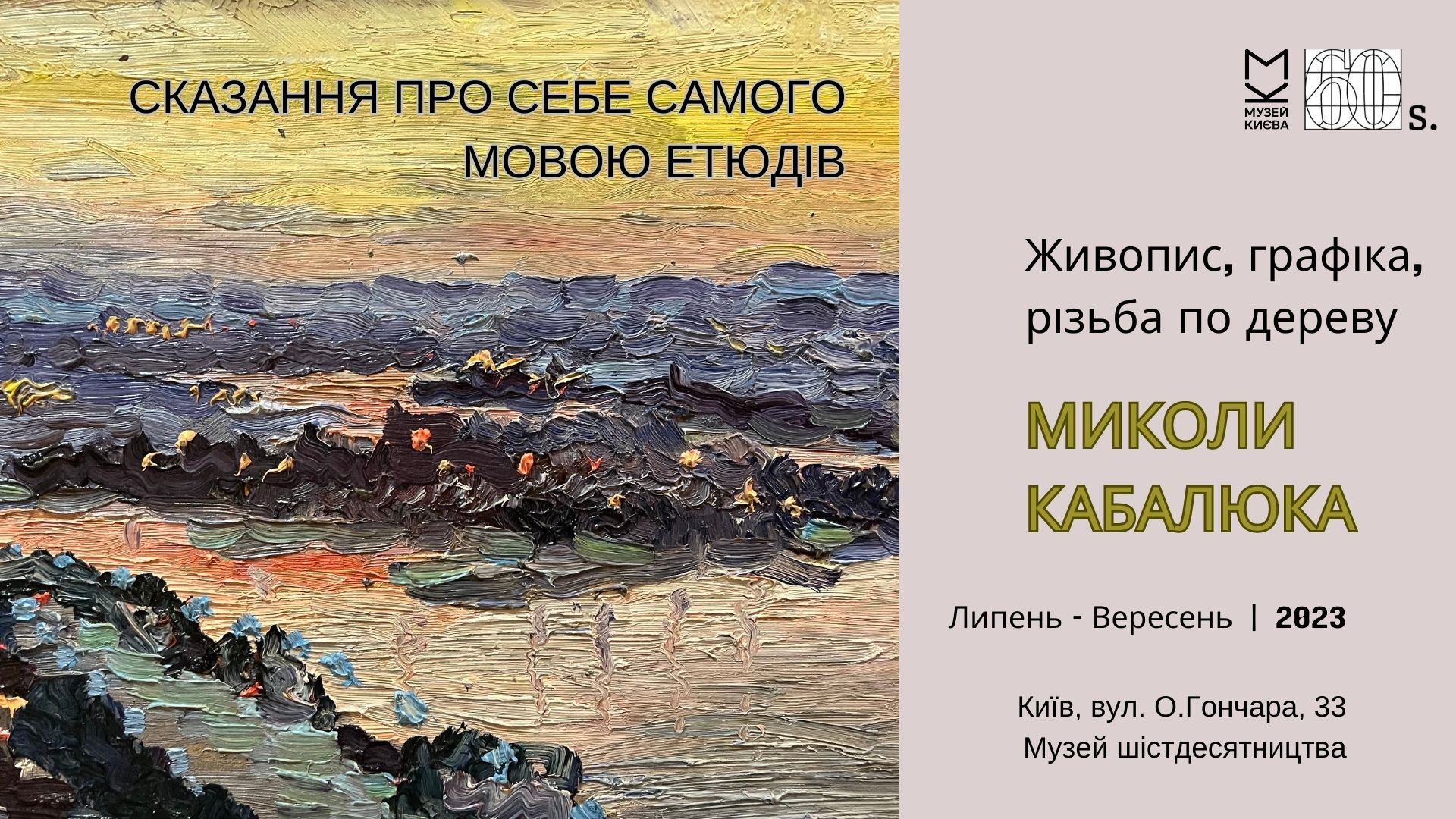
The generation of the Sixtiers, as it recedes in time, attracts increasing attention, leading to a deeper exploration of contexts, nuances, and the emergence—like from old photographic film—of names previously unknown to the wider public. For this reason, the Museum of the Sixtiers is launching a series of exhibitions dedicated to notable figures of the Sixtiers movement, who belonged to nonconformist circles and filled 1960s Kyiv with Ukrainian cultural meaning. The first exhibition in this series is devoted to the work of the self-taught artist from Vinnytsia, Mykola Kabalyuk (b. 1941).
Mykola Kabalyuk moved to Kyiv after his military service (1965) to pursue a degree in architecture. From that time, his social and creative life flourished. In his own words:
“I joined the choir ‘Zhaivoronok,’ which began its existence at the Club of Creative Youth ‘Suchasnyk’ in the early 1960s. We sang many Ukrainian songs, and at New Year we would go caroling in groups around the city, performing carols on Khreshchatyk. On Taras Shevchenko Days, March 9 and 10, and always on May 22, the choristers would go to the Taras Shevchenko monument and there, together with other participants, sing, recite poems, listen, and deliver speeches. In 1967, the police were particularly harsh, dispersing the unsanctioned event on May 22—several participants were arrested, and the outraged crowd marched in a column to the Central Committee of the Communist Party of Ukraine demanding their release…”
The circle of creative friends inspired him to try himself in various genres, recalling his childhood and adolescent fascination with drawing. Mykola Kabalyuk’s oil paintings from the second half of the 1960s depict Kyiv landscapes, views of the Left Bank before it was filled with skyscrapers, and urban architectural compositions that merge the old with the new. His Kyiv friend, graphic artist Vasyl Vecherskyi, allowed the talented architect to work in his studio. There, Mykola Kabalyuk learned the technique of linocut, creating original bookplates and other small graphic works for close friends and family, which are also included in the exhibition.
Today, Mykola Kabalyuk lives in Kyiv, cares deeply about Ukraine, and wholeheartedly supports his 29-year-old grandson, who is currently at war. Creativity remains a constant necessity for him, expressed mainly through woodcarving—or, as he himself puts it, “a conversation with wood.” The artist insists that he never knows in advance what the result of his work will be. Wood is alive and warm; its structure seems to suggest the shape of the future piece—it is only necessary to listen to its language. The philosophy of Mykola Kabalyuk’s art is best expressed in his own words:
“One must talk to the wood
and constantly ‘listen’ to it…”
“The most interesting work is the one that is not yet finished.
It gives birth to everything in the process, more than I can even enumerate…”
And the best way to tell the story of Mykola Kabalyuk is through his sketches, presented in the temporary exhibition hall of the Museum of the Sixtiers.