
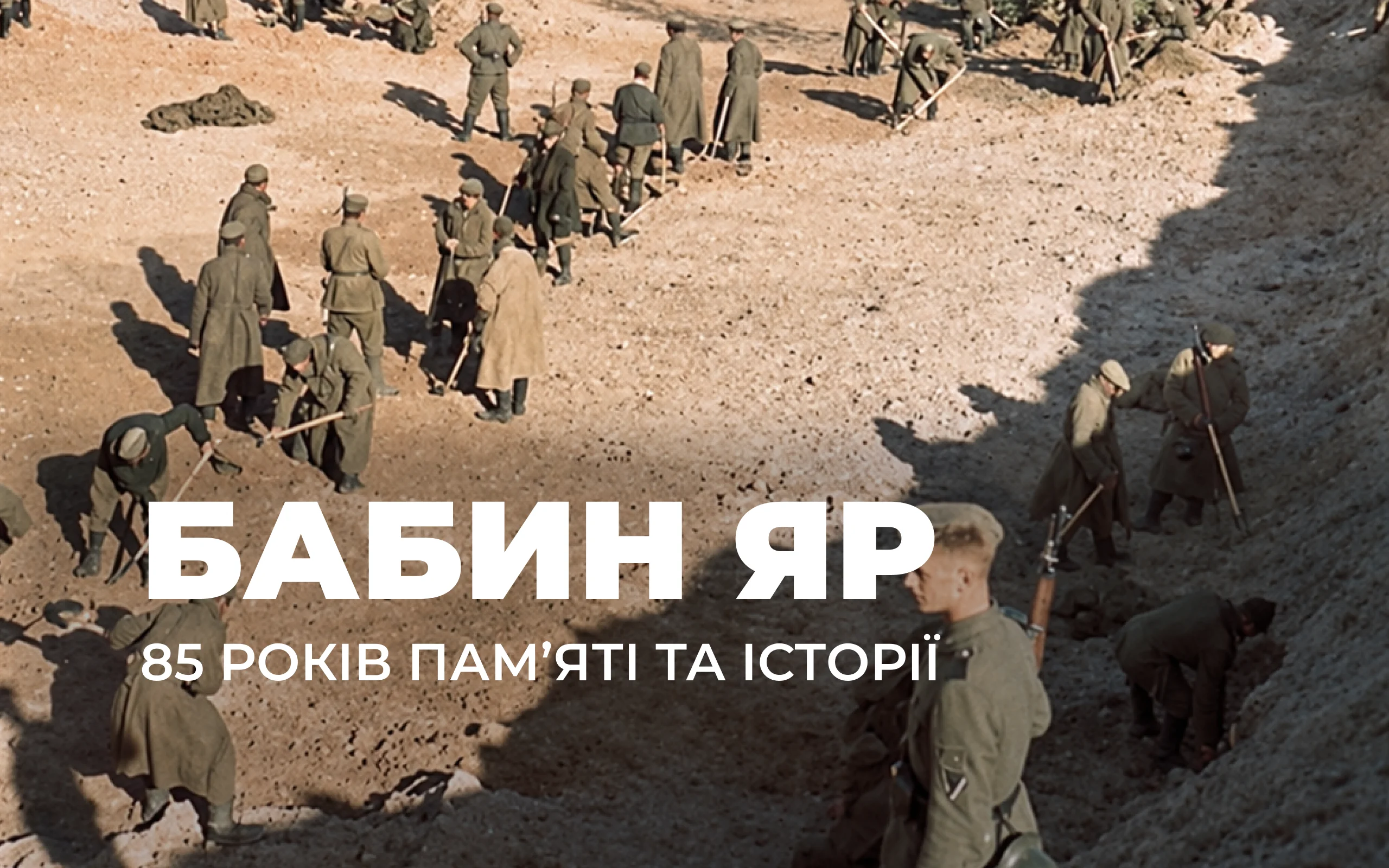
2026 marks the 85th anniversary of the Babyn Yar massacre. It is not only the anniversary of one of the darkest crimes during the Nazi occupation. For decades, the history of the Babyn Yar has mirrored the history of Kyiv and Ukraine itself – war and occupation, the Soviet policy of silence, the difficult recovery of historical memory by society, and, ultimately, the modern Russian-Ukrainian war.
On September 29-30, 1941, the Nazis shot 33,771 Kyiv Jews in the Babyn Yar ravine. It became one of the largest mass massacres of civilians during the World War II and one of the most horrific symbols of the Holocaust. Between 1941 and 1943, the mass shootings at Babyn Yar never stopped. The victims also included Roma, civilian hostages, psychiatric hospital patients, Soviet prisoners of war, communists, members of the Soviet underground, and figures of the Ukrainian liberation movement. The total number of people killed in Babyn Yar and related with it sites reaches about 100,000.
Among the victims there were people, whose names are inextricably connected with Ukrainian Kyiv, notably the prominent poet Olena Teliha and other members of the OUN underground. The Babyn Yar tragedy was the epicenter not only of the Holocaust history, but also a tragedy for the entire occupied city, where Nazi terror ruthlessly targeted various population groups.
After the expulsion of the Nazis in the autumn of 1943, the history of the Babyn Yar took on a new dimension. The Soviet authorities had no interest in revealing the true scale of the tragedy, particularly the total extermination of the Jewish population. The remembrance of the victims was either hushed up or tightly controlled by the official ideology. At the same time, the regime tried to physically destroy the site of the Babyn Yar itself by deciding to flood it with sludge from brick factories.
An attempt to erase memory turned into a new tragedy: on March 13, 1961, a dam collapse caused the Kurenivka mudslide. A deadly torrent of pulp rushed toward Kurenivka, destroying residential areas and infrastructure, and claiming the lives of hundreds of Kyiv residents. This man-made disaster was a direct consequence of the Soviet policy of oblivion.
Despite decades of repression, the memory of those executed has not faded. In September 1966, on the 25th anniversary of the tragedy, Kyiv residents openly gathered in the Babyn Yar for an unauthorized rally to honor the victims. The tragedy gradually returned to the public consciousness through the efforts of dissidents, writers, and human rights activists. Although the Soviet government established a monument to «Soviet citizens and prisoners of war» in 1976, the actual scale and national background of the victims were to remain unrecognized officially for much longer.
With the restoration of Ukraine’s independence, the Babyn Yar became one of the main sited of historical memory in the capital. There have been erected monuments and signs dedicated to different groups of victims. The memory of Babyn Yar has ceased to be the part of a state-imposed, unified narrative, becoming instead a subject of public reflection, ongoing «memory wars», and a space of confrontation, complex dialogue, and sharp debate.
On March 1, 2022, 80 years since the beginning of Nazi mass shooting, war has come to the Babyn Yar once again. During the Russian missile strike on Kyiv, the area near the TV tower, close to the memorial complex, was hit. For Ukrainians, this became a tragic reminder that the history of the Babyn Yar did not end in the past.
Today the Babyn Yar is not only a place of sorrow. Its 85-year history is a reflection of Ukraine’s own destiny: from Nazi terror, through Soviet silencing and the struggle for the right to remember, to an independent state, that right now, with arms in hands, is defending its right to its own history, freedom, and future.