This year we celebrate 260s anniversary of Andriy Ivanovych Melensky (1766-1833) – the first Chief Architect of Kyiv in 1799-1829.
Andriy Melensky became a prominent figure in the history of our hometown. The great achievement of Melensky is the way Kyiv looks like today. During 30 years he managed the Gubernia Drafting Bureau and participated in developing a master plan for Kyiv in 1803-1809. The urban development measures, carried out under the leadership of Melensky, largely determined the modern nature of planning structure of the central part of the city. Andriy Melensky passed into the history of Kyiv Architecture as an outstanding interpreter of Classical style.
Urban planning principles
Historical uniqueness of Kyiv planning lies in the fact that due to very rugged terrain, it stretched along the Dnipro River in the form of three settlements. Podil, Pechersk, Old Town – these parts of the city mostly developed independently and existed separately until almost the late 18th century. Merging separate parts of the city into a single whole in the late 18th – early 19th centuries, became the main goal of the city development, which could be finally determined only after improvement of the city transport. Activities of Andriy Melensky as the Chief Architect were closely related to the road construction on the territory of city.
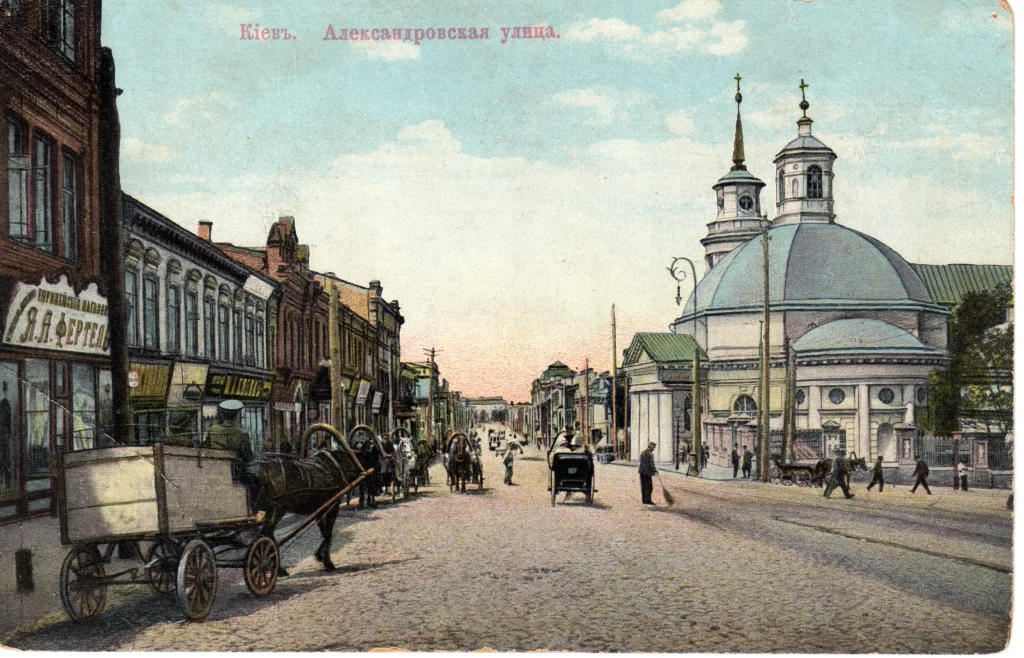
Andriy Melensky owns the idea of building major urban arterias, among them Oleksandrivska highway (today it is Sahaidachnoho and Mykhaila Hrushevskoho streets) and Vasylivska highway (today it is Velyka Vasylkivska street), and also Khreshchatyk street, which in the middle of the 19th century became the main street of Kyiv. In the same time, in 1806, 1809 and 1811, there was designed the development of the new district of Kyiv – Palace part (Lypky), to connect it with Khreshchata Valley.
The great value for the further development of the city had development of Khreshchata valley. It led to a merging of Sofiivska part, Pechersk and Podil into the one whole city. Despite the fact that Khreshchatyk, formally, was located in the center of the city, at the beginning it was constructed very slowly.
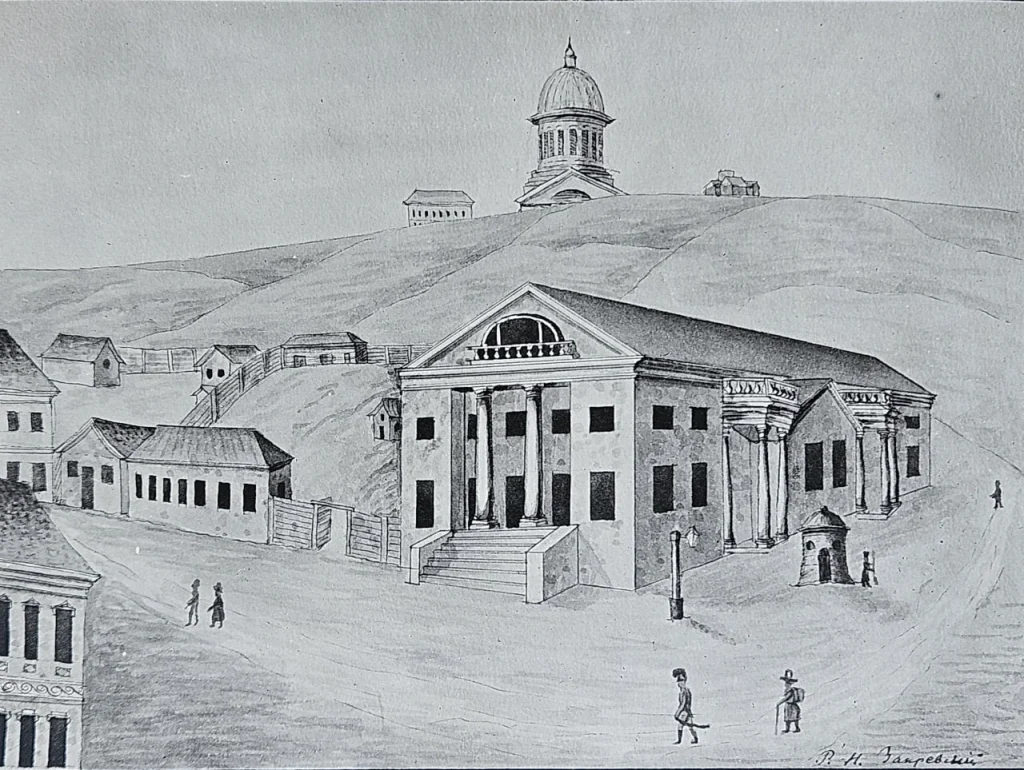
In the early 19th century the most notable building on Khreshchatyk was the building of Kyiv theatre. It was the first public building on the highway (the building was not saved; today there is the building of the National center «Ukrainian House»). The place for construction was chosen brilliantly, as it was located at the equal distance from all the three parts of the city. Moreover, it was located at the new highway – Khreshcvhatyk, which was going to become the central street of the city. The city theater was constructed by the project of Melensky in 1803-1806 and had the great importance for the further development of Khreshchatyk. In those days the building of the city theater was huge, so it brought a certain scale into the street composition and determined the nature of the construction of residential and public buildings on Khreshchatyk.
Classical architecture
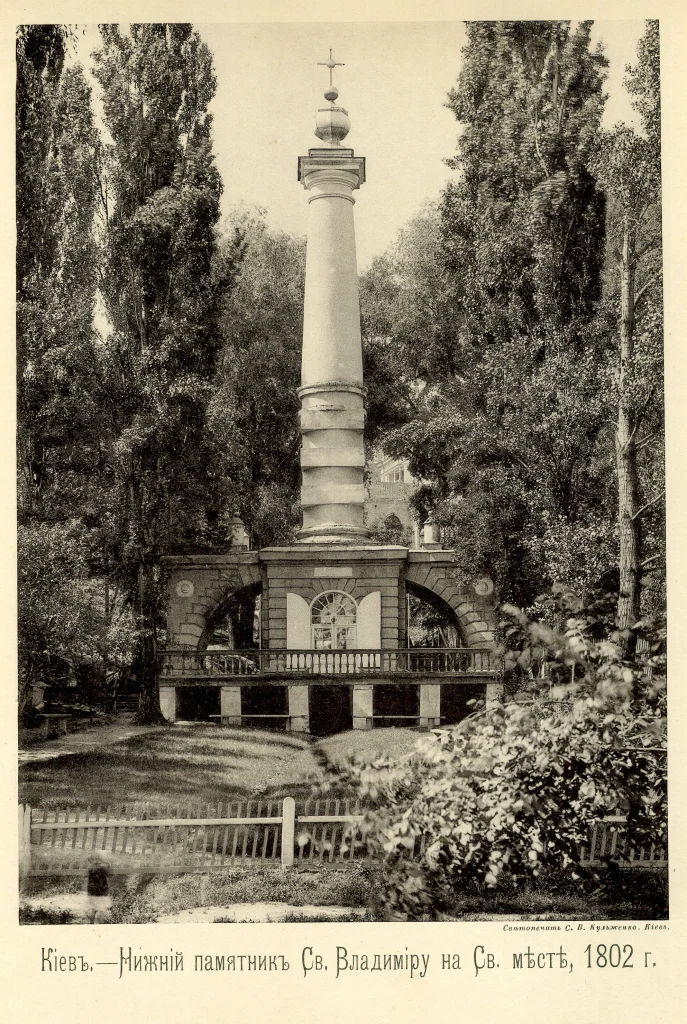
One of the first Melensky’s works in Kyiv was the Monument to the Magdeburg Rights, built in 1802 – 1808 рр. By design, it was one of the most interesting constructions of Melensky. There we can feel the purity of forms, which was typical for this master. This monument is the oldest one in Kyiv, and it is one of the few monuments, saved in Kyiv in the Empire style.
Before the Great Fire in Kyiv in 1811, construction of a number of churches began. Andriy Melensky was a devoted admirer of the Classicism style. That is why all his constructions have slender columns, elegant rotundas and semicircular arches, which were typical for this architectural style. In 1800-1807 was built the Saint Mykola Dobroho Church on Pokrovska Street, which was one of the central streets on Podil. The west façade of the Church was tetrastyle portico with triangular pediment and two round towers – bell towers with hemispherical domes. Unfortunately, the Church was destroyed in 1930s.
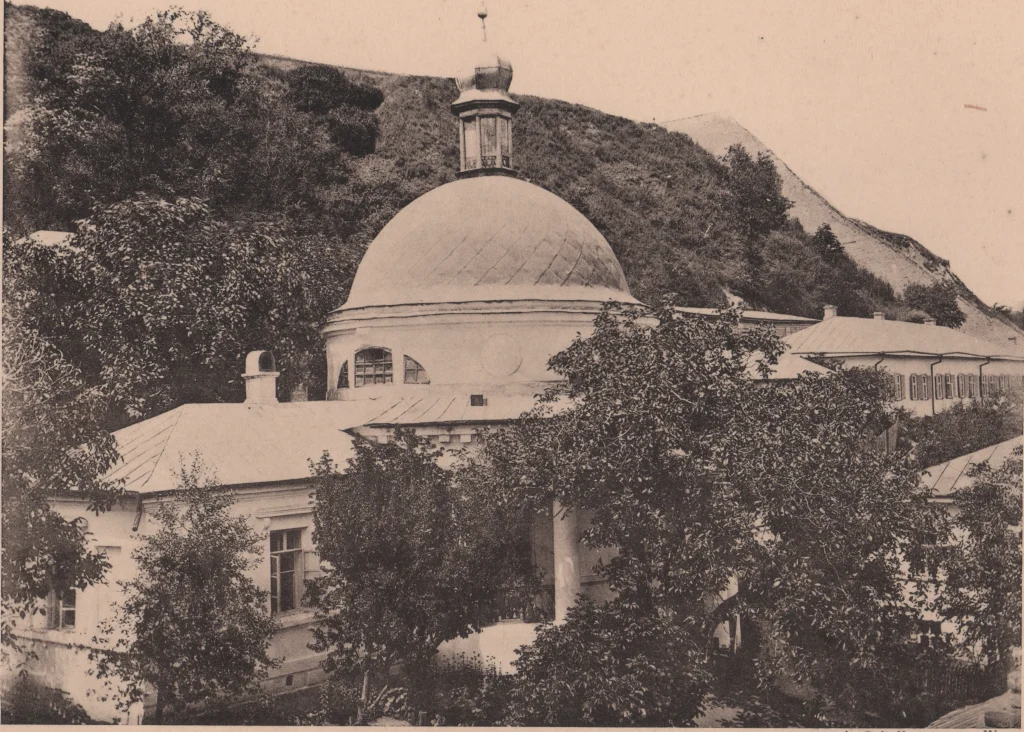
Andriy Melensky for the first time brought to Kyiv rotunda churches. In 1808-1810 such rotunda church was built at the Askold’s Grave. Architect Melensky made good use of the theme of circular temple, which was very common in the Classical period. Hemispherical dome created beautiful and logical construction of the building. As art historian Fedir Ernst said, in the 19th century this typical for the Classical period building became one of the most favorite among Kyivans and the guests of the city. Around the Church, on the slopes, was located the cemetery, which had row of graved of the famous Kyivans. In 1930s the cemetery was closed, and in 1934-1936 rotunda Church of St. Nicholas on Askold’s Grave was rebuilt as a pavilion. In 1997 the Church was reconstructed.
The building started in 1808 under the personal guide of the author of the project. In 1809 there were constructed walls and temporary roof for winter time. By the beginning of the 1811 there was ready bell tower with several church bells. Devastating fire of the 9th of July 1811, which destroyed almost the whole Podil, stopped the building works. The temple itself did not suffer fire damage, except some wooden items, located behind the Church, among which was the old iconostasis. As many parishioners went broke, they could not donate as earlier, so the construction works slowed down. The dome construction was complete only in 1913. On February 1814, a newly built Church of the Nativity was consecrated.
On May 6-7th (18-19th) 1861, in the Church of the Nativity on Podil there was placed a Cremation Urn of the poet Taras Shevchenko, which was transported from St. Petersburg to Kaniv. Dean of all the Podil churches Archpriest Petro Lebedyntsev and priest in charge Yosyp Zheltonozhsky served a Panakhida for the poet in front of the mass gathering of Kyivans. After that event the temple was called «Shevchenko Church». In 1935 the Church of the Nativity was closed. During some period of time the building was used as a dormitory. But one year later the Church was barbarically destroyed together with the other landmarks of Ukrainian history and architecture.
In 2002-2005 the Church of the Nativity was rebuilt as a great landmark, related to Taras Shevchenko. Reconstruction of the Church of the Nativity on Poshtova Square returned Kyiv the great landmark of architecture and history – «Shevchenko Church», and enriched the panorama of Podil.
Reconstruction of Podil after the Fire 1811
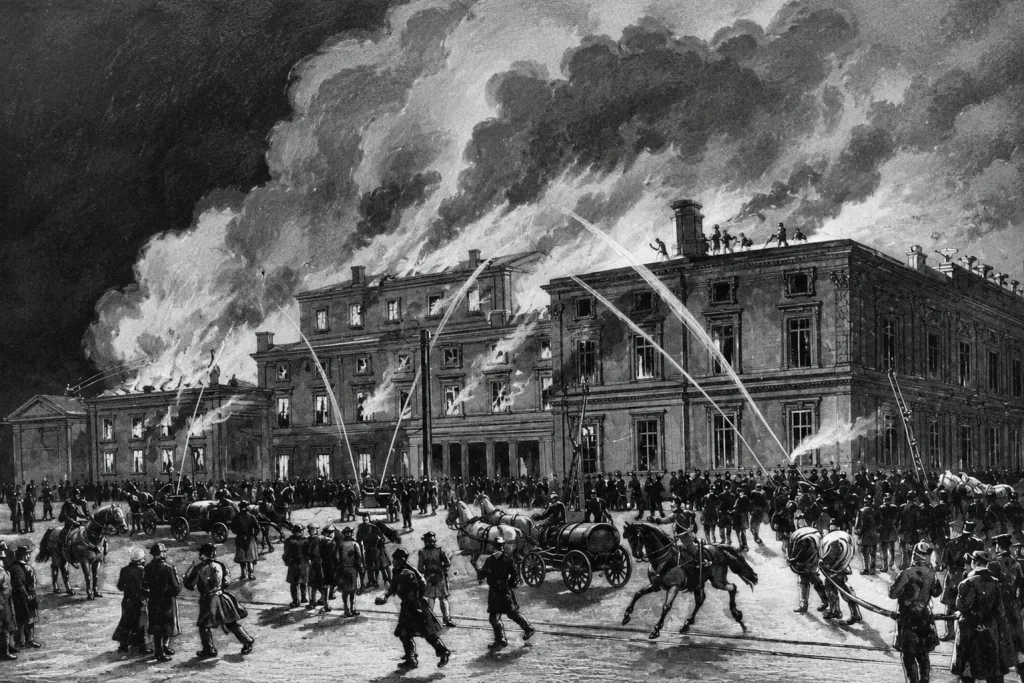
The Fire of the 9th of July 1811, which destroyed almost all the buildings of Podil, became a catalyst for fundamental change. Andriy Melensky designed his Development Planning of this part of the city. The main idea of the Planning was conservation of the old medieval radial street layout. The existing communication system, gutters, and surviving buildings were taken into account. But this Plan was rejected, and Podil Planning after the Fire was entrusted to Petersburg architect William Hastie. He created a rectangular grid without taking into account the local topography, and preserved historical radial plan. It was Melensky who brought closer to the natural landscape Hastie’s rectilinear street grid.
After the Fire 1811 also was fully completed Kontraktova Square. There was approved the Hastie’s project, where supposed to be complex of buildings, which would unite Magistrate, Contacts House and post office. All this supposed to look like symmetrical composition with the Magistrate in the center. But from the entire building complex there was constructed just the right side in 1817. Andriy Melensky managed the construction of Contracts House.
During the rebuilding of churches and civil houses, Melensky usually did not save their original appearance. In this case, he acted like the representative of aesthetic principles that were established in architecture at the time. He could not imagine his creativity outside classicism. That is why, even during the minor renovations of the buildings, the architect gave them the features of classicism. Only when he worked with unique landmarks of past centuries, Melensky preserved their original appearance. For example, like the Epiphany Cathedral of the Kyiv Epiphany Brotherhood Monastery.
From the Fire on Podil the most suffered complex of buildings of the St. Florus Ascension Convent. Architect Melensky worked on creation of its architectural ensemble and he managed to combine harmoniously Baroque style and Classicism. He did not just restored structures, but also constructed new ones. In 1821 Melensky restored the monastery’s bell tower, and in 1824 – Church of Resurrection with semicircular colonnade approached by two beautiful staircases. The structure of the building is somewhat similar in character to civil, not church building. The Church blends in perfectly with the whole monastery ensemble and surrounding nature. The Abbess’s house, built in 1818-1821 by the project of Andriy Melensky in Classicism, is one of the best architect’s works.
On Khoryva Street, 13/11, the house of the famous architect Melensky has survived. This is the brilliant example of typical Podil architecture in Classicism of the early 19th century.
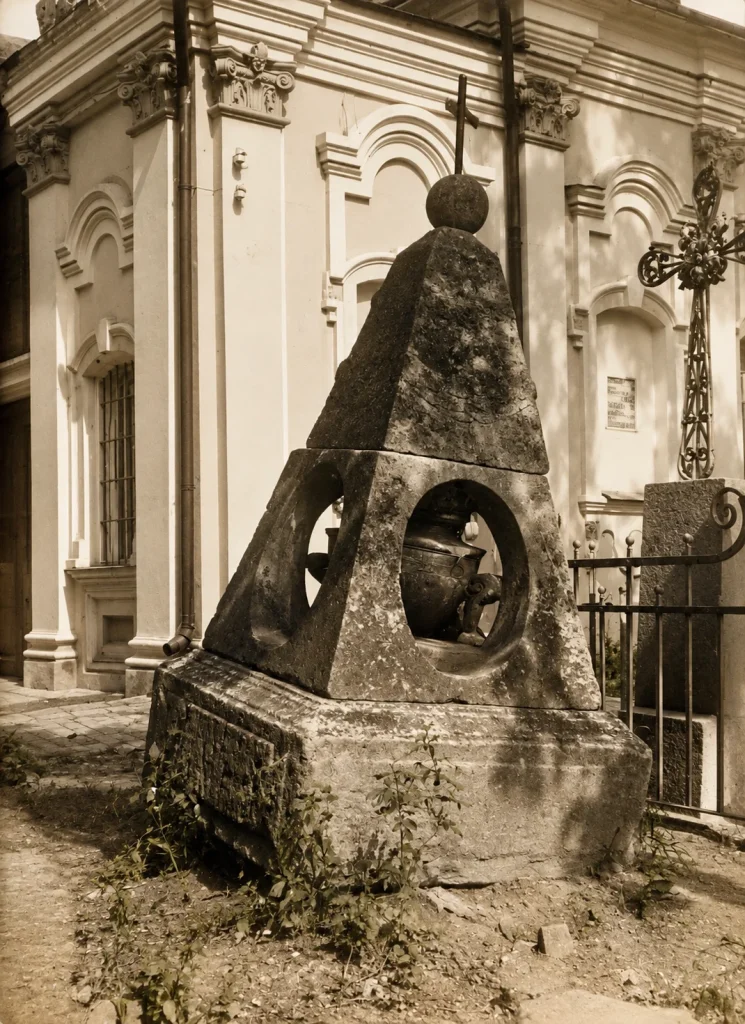
In 1829 Andriy Melensky left the position as an architect because of the health problems, but continued architectural practice. He died in 1833 and was buried at the Schekavitsky Cemetery. On his grave there was erected a monument, whose architecture attracted the attention of art critics, artists and photographers. The description of the monument can be found in the guidebook «Kyiv», 1930: «One of the most interesting gravestones in the shape of a pyramid with a cremation urn underneath it…». Schekavitsky Cemetery was destroyed in 1930s. The gravestone was gone in 1950s.
There were constructed over 50 outstanding architectural landmarks and urban planning objects, designed by architect Melensky. Buildings, constructed by his designs in Classicism, or rebuilt with his participation, still exist in the city’s historical built environment. Andriy Melensky was the first Chief City Architect and now we call him the Father of the new epoch in the development of Kyiv’s architecture. He was the person, who made Kyiv as we see it nowadays.