
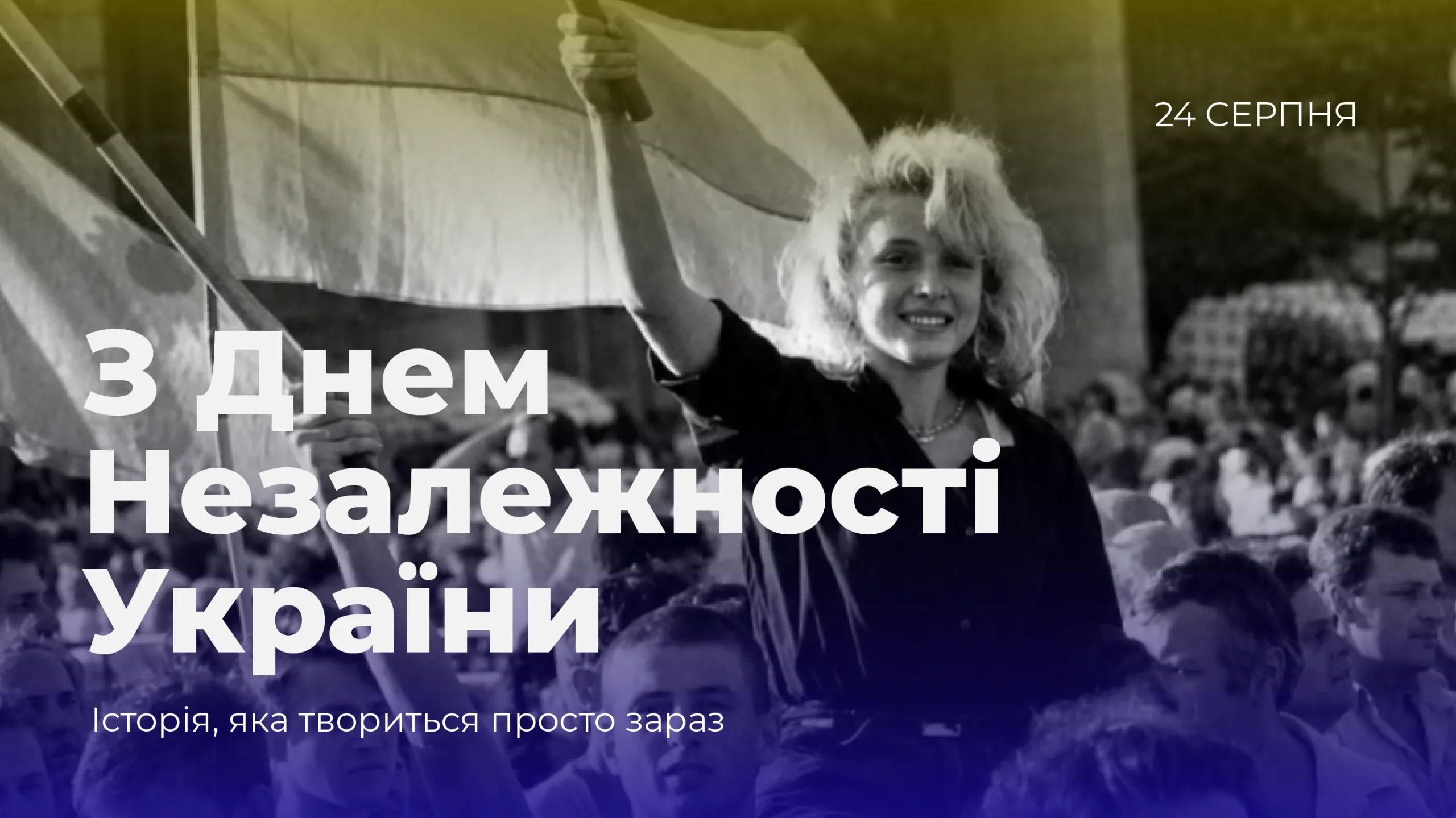
On August 24, 1991, Ukraine restored its independence. In Kyiv, this decisive step had been ripening throughout the preceding events: on July 16, 1990, the Verkhovna Rada of the Ukrainian SSR adopted the Declaration of State Sovereignty, and on July 24 the blue-and-yellow flag flew for the first time over the Kyiv City Council building. That same autumn, the Revolution on Granite erupted on what was then October Revolution Square — the first nonviolent Maidan of modern Ukraine. In August 1991, it was the capital that became the epicenter of adopting the Act of Declaration of Independence, finally confirmed by the all-Ukrainian referendum on December 1.
The events of 1991 marked not the creation of a state from nothing, but the restoration of its interrupted self-determination. The Ukrainian state tradition originates from the early Rus’ state of Kyiv and stretches across centuries — through the Galicia-Volhynia Kingdom of the 13th–14th centuries, the Cossack state of the 17th–18th centuries, and the Ukrainian People’s Republic and Ukrainian State of 1917–1921. Kyiv has always remained an unshakable center of this continuity, and Saint Sophia’s Cathedral, the Kyiv Pechersk Lavra, and the city’s centuries-old landmarks preserve material evidence of our deep roots.
In the 20th century, Ukrainians twice attempted to win independence — during the Struggle for Liberation of 1917–1921 and during the years of World War II. Each time, Kyiv became the arena of state-building and resistance: the Ukrainian Central Rada operated here, its Universals were proclaimed here, and Sofiivska Square went down in history as the place where Hetman Pavlo Skoropadskyi was elected and the Act of Unification (Zluka) of 1919 was proclaimed. In 1941, under Nazi occupation, it was in Kyiv that the Ukrainian National Council arose as an attempt to revive a Ukrainian state center.
The chief enemy and obstacle to Ukrainian self-determination has always been Muscovy — Russia. From the destruction of the Cossack order to the imperial eradication of language and culture, from Soviet totalitarian terror to today’s war of aggression, the enemy has consistently sought to deny Ukrainians’ very right to their own state and civilizational path.
The restoration of independence in 1991 opened a new stage in the struggle for freedom. The Revolution on Granite, the “Ukraine without Kuchma” campaign, the Orange Revolution, and the Revolution of Dignity all demonstrated the maturity of a civil society capable of defending sovereignty and Ukraine’s European course. Kyiv’s maidans became spaces where the modern Ukrainian political nation was forged.
Today, defending independence means defending a distinct Ukrainian civilization — its drive toward freedom, democracy, self-governance, and the creative development of spiritual and material life. The heroic defense of Kyiv in February–March 2022 broke the invader’s plans and once again proved the unbreakable spirit of Ukrainians. Despite daily missile and drone strikes, the destruction of civilian infrastructure, and the trials of war, the capital holds its ground, remaining the heart of national resistance.
Today, Kyiv is a living symbol of state-building continuity. Here the foundations of Rus’ were laid, the fateful decisions of the 20th century were made, independence was won in the 1990s, and the will of today’s Maidans was forged. The history of Ukrainian independence continues right now — in the resilience of the capital, the feats of the Armed Forces, and the struggle of the whole nation for a free and independent future.