
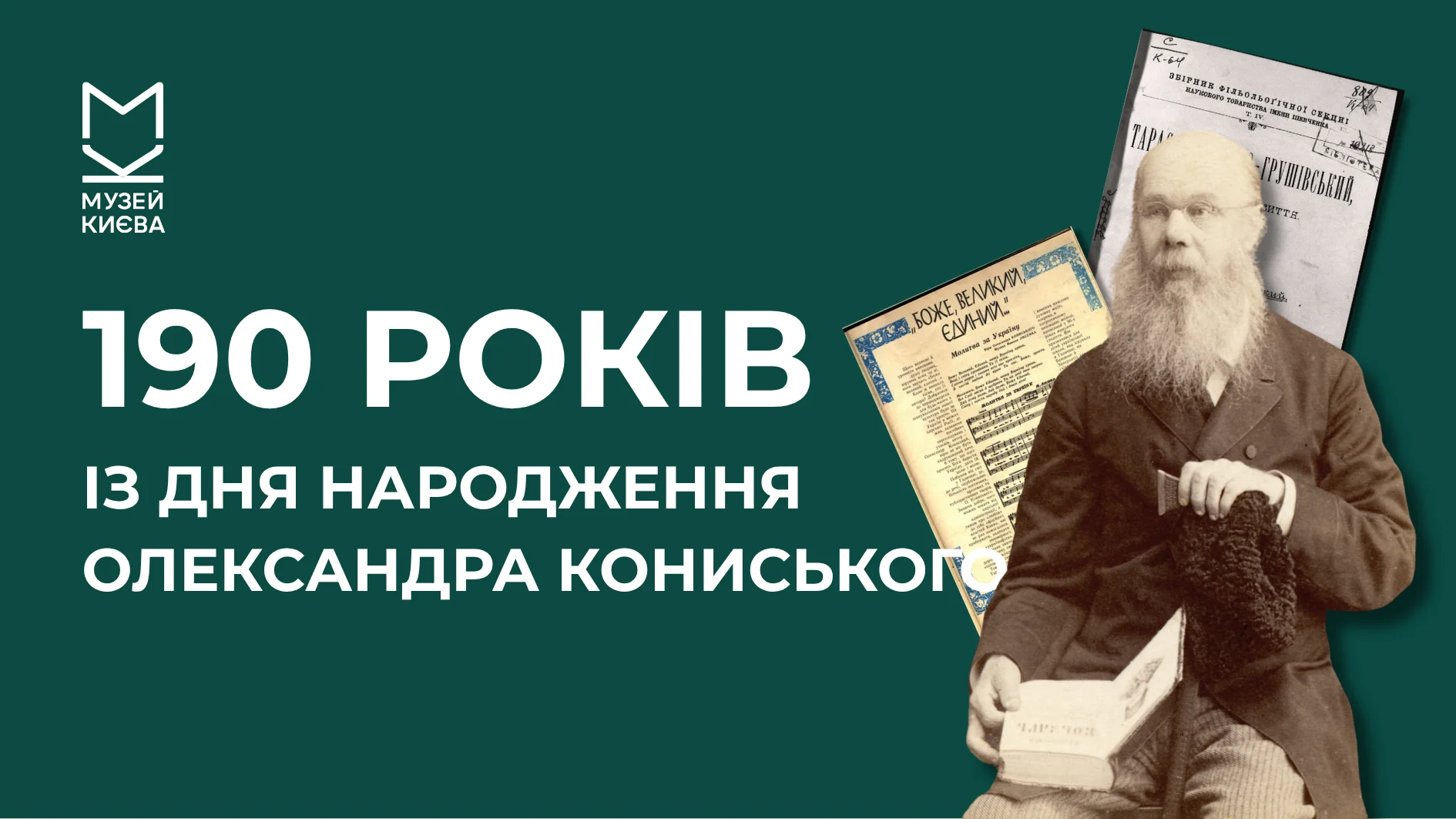
On August, 18th is the 190th anniversary of the birth of Oleksandr Konyskyi (August, 18th, 1836 – November, 29th, 1900) — writer, publicist, translator, publisher, lexicographer, educator and public figure, author of the spiritual hymn «Prayer for Ukraine». Konyskyi was one of the most active defender of Ukrainian heritage, who devoted his life to Ukraine. Because of his uncompromising commitment to Ukrainian cultural separation and distinctness from Russia, contemporary Ukrainophile wrote about him: «a towering and controversial figure…». And modern scholars view him as one of the founding fathers of the Ukrainian identity — thinkers and intellectuals, who shaped the Ukrainian nation.
Oleksandr Konyskyi was born in the famoly of impoverished nobleman from Chernihiv; studied in Nizhyn Noble School and Chernihiv Gymnasium. He began his professional career in legan practice, hoping to protect the interests of «liberated serfs» after the peasant reform of 1861. At the same time, he carried out literary and public activities, and organized Sunday schools where he also taught. He published Ukrainian copybooks and arithmetic textbooks for primary schools, set up a library in his own apartment in Poltava and worked there as a librarian, and organized literary-musical evenings and theater studios. At the same time, he was a regular correspondent of the first scientific and literary journal «Osnova», which was published from Panteleimon Kulish’s printing house, and studied the problems of public education and schooling. All his work aimed to fight for native national rights on his own land—teaching, lecturing, and printing in Ukrainian. His proactive position in 1863 brought accusations of spreading “Little Russian” propaganda and criticizing the local administration, ultimately causing him to be exiled to Vologda. In 1872, the police surveillance over Konyiskyi was lifted, and he moved to Kyiv.
Konyskyi’s Kyiv period was no less turbulent and fruitful — he continued to carry out extensive scientific, cultural, publishing, and educational work. In 1873, he became one of the initiators of the foundation of the Shevchenko Literary Society in Lviv. He was not stopped by the Ems Decree of 1876, which banned the printing of Ukrainian scientific and popular books, as well as textbooks. In 1878, Konyskyi was elected as a deputy to the Kyiv City Council, a status he also used to benefit the Ukrainian word and language. He tirelessly promoted education in the Ukrainian language in public schools, compiling and attempting to publish Ukrainian textbooks. Unfortunately, permission to print his «Chytanka» («Reader») and the collection of Ukrainian works «Batkivshchyna» («Homeland») was denied; however, he succeeded in publishing the Ukrainian textbook «Hramatka, abo Persha Chytanka zadlia Pochatku Vchenia» («Grammar, or the First Reader for Beginning Education»). With the support of Konyskyi, the department of Ukrainian history with instruction in Ukrainian was founded at Lviv University in 1894, headed by Professor Mykhailo Hrushevskyi. Oleksandr Konyskyi reopened a public reading room in his Kyiv apartment.
Oleksandr Konyskyi was a versatile master of the written word, writing poetry, short stories, novels, essays, reviews, and journalism. He was Taras Shevchenko’s first major biographer, publishing the foundational two-volume study «Taras Shevchenko-Hrushivskyi: Chronicle of His Life» in 1898 after a decade of research.
In 1885, Oleksandr Konyskyi wrote the lyrics to the song «O Great and Only God», for which, as Konyskyi wrote himself, «Mykola Lysenko set it to music and provided a very fine melody that everyone liked». Thus, our well-known «Prayer for Ukraine» was born, which, in the arrangement by Oleksandr Koshyts, became the spiritual anthem of Ukraine.
It is hard to cover Konyskyi’s biography in a single post; he had incredible energy and productivity, and played a huge role in the national liberation movement of the second half of the 19th century. The main cause of his life, to which he completely dedicated himself, was «to grow such a tree on national soil that the well-being of all the people of Ukraine would blossom beneath its wide canopy».
Unfortunately, Konyskyi’s figure remains little-known and undervalued compared to the greatness and significance of his work. In Soviet Ukraine, his works were banned and his name was forgotten. The surviving part of his creative legacy is now kept at the Institute of Literature and the Vernadsky National Library. Original lifetime and memorial editions of his works are also kept in the funds of the Museum of Kyiv History.
The renaming of Kyiv’s central Turgenivska Street to honor a true Ukrainian and cultural figure was a joyful event. In March 2023, as part of the decolonization of the capital’s-toponymy, Turgenivska Street was renamed Oleksandr Konyskyi Street.